

Educational Brain Breaks That Get Kids Moving and Learning
Educational brain breaks are short classroom activities that pair movement with literacy or math review. Students reset their bodies and practice something they already know — without turning the break into another full lesson.
By Brittany, former kindergarten teacher and founder of Fluency & Fitness+
What is an educational brain break?
An educational brain break is a short classroom activity that combines physical movement with academic review. Instead of a movement-only video, students might read a word and jump, solve a math fact and stretch, or practice a phonics skill while moving.
For PreK–3rd, keep it simple: use a skill students have already been taught, add an easy movement, and stop while it still feels like a reset — not another lesson.
Why combine movement with learning?
Young students are asked to do a lot of sitting, listening, and focusing throughout the school day. A short movement break gives their bodies a chance to reset. When the movement is paired with a familiar academic skill, teachers can also squeeze meaningful review into minutes that might otherwise be lost.
That doesn’t mean every break needs to be educational. Kids still need recess, free play, and movement just for fun. Educational brain breaks are simply another tool for moments when you want movement + review at the same time.
Movement-only breaks still matter. Use educational ones when you specifically want review baked into the reset.
From my classroom
My last year teaching — around 2014 — schools were saying every minute had to count. You couldn’t just do fun brain breaks anymore. That pressure is what sparked Fluency & Fitness: fun movement that still incorporates learning, because every second was supposed to be educational. Before that year, I didn’t really have a set plan for when a break should be educational and when it should just be fun.
Wake up bodies and quickly review what students already know.
Use movement to make transitions feel purposeful.
Give students a chance to stand, stretch, hop, or move.
Revisit phonics, high-frequency words, vocabulary, or math facts.
7 easy educational brain breaks you can use today
You don’t need a special program to try the idea. Start with something students already know and add a simple movement.
1. Read + Move
Show a letter, word, or sentence. Students read it aloud, then do one quick movement (reach, squat, march, twist, or jump). Works beside desks; about 1–2 minutes.
2. Solve + Stretch
Display a math fact or quick problem. Students solve, say the answer, then stretch high, touch toes, or balance. Keep each round short.
3. Sound + Action
Say or show a target phonics sound. Students repeat the sound and match it with one action. Swap the sound as your phonics focus changes so it stays review, not new teaching.
4. True or False Moves
Give a literacy or math statement. Students hop or stand for true and freeze for false, then you confirm the answer in one sentence. It’s an easy way to get the whole class answering at once.
5. Find It + Move
Place 3–4 answers around the room (sticky notes or cards). Call a prompt; students point or walk to the match. Best when you have a little floor space.
6. Count + Move
Count forward, backward, or skip-count while marching or clapping. Stop on a signal and ask, “What number are we on?” so the movement stays tied to number sense.
7. Vocabulary Charades
Act out a vocabulary word with gestures; classmates guess, then everyone says or uses the word once before the next card. Keep the word list small so the activity stays quick.
Ready-to-play option
Fluency & Fitness+ has ready-to-play activities that pair literacy or math practice with movement, so you don’t have to build the prompts yourself.
Looking for kindergarten-specific ideas? See Kindergarten Brain Breaks.
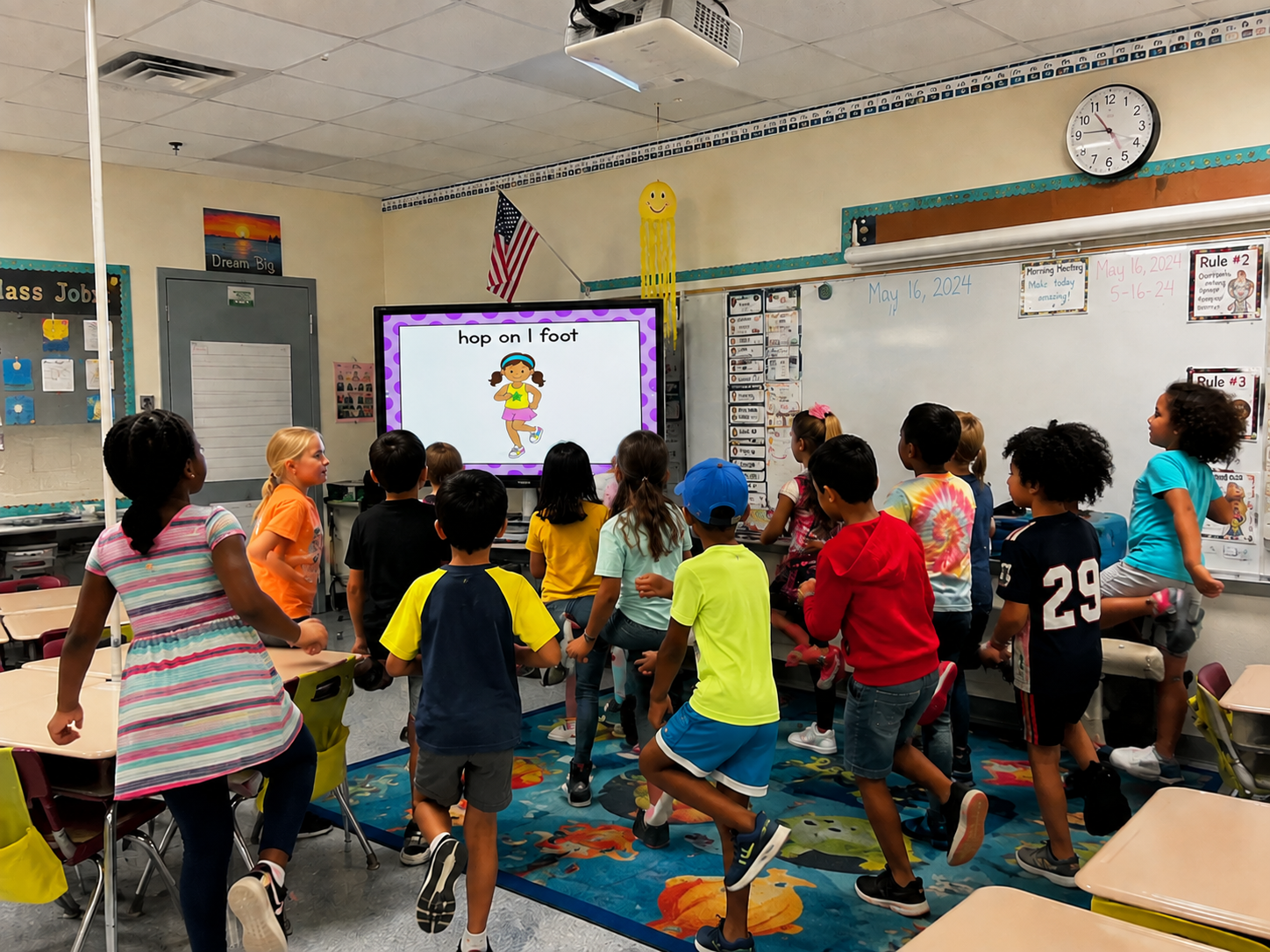
Students follow a Fluency & Fitness+ movement activity while practicing grade-level skills together.
Brain break ideas by grade and skill
The movement can stay simple while the academic skill changes with your students.
Literacy: letters, names, rhyming, beginning sounds
Math: counting, shapes, colors, comparing
Literacy: letter sounds, CVC words, high-frequency words
Math: number sense, addition/subtraction within 10, teen numbers
Literacy: phonics patterns, decoding, word recognition
Math: addition/subtraction, place value, comparing numbers
Literacy: phonics, vocabulary, fluency, grammar
Math: facts, place value, skip counting, measurement
Literacy: vocabulary, morphology, fluency, grammar
Math: multiplication, division, fractions, place value
Explore more movement + learning ideas
This page is the starting point. These guides go deeper into specific classroom needs:
Movement ideas made specifically for kindergarten.Learning + Movement →
Ways to build movement into the classroom day.Phonics with Movement →
Active phonics practice for early readers.Indoor Recess Ideas →
Keep kids moving when you’re stuck inside.Classroom Transitions →
Quick movement ideas between parts of the day.Moving Word Practice →
Pair high-frequency word practice with movement.
Want the movement + learning already made for you?
Fluency & Fitness+ gives PreK–3rd teachers ready-to-play literacy and math activities with movement built in—plus Fluency Find It, task cards, Physical Phonics, custom games, assignments, playlists, and more.
See Membership OptionsGet Free ActivitiesEducational brain break FAQs
How long should an educational brain break be?
Keep it short enough to feel like a reset. In many PreK–3rd classrooms, a few minutes is plenty, but the right length depends on the age of your students, the activity, and what comes next in your day.
Do brain breaks have to be educational?
No. Movement for fun, recess, and free play all have important places in the school day. Educational brain breaks are useful when you want to combine a quick movement opportunity with review of an already-taught skill.
What skills can you practice during a brain break?
Almost any quick-response review skill can work: letter sounds, phonics patterns, word recognition, vocabulary, counting, number sense, addition, subtraction, multiplication facts, and more.
Do I need special equipment?
No. Many movement breaks can be done beside desks with no equipment at all. A screen can make ready-made activities easier for whole-class use, but simple teacher-led movement works too.
What is the difference between a brain break and Fluency & Fitness+?
A brain break is the general idea of pausing for a short reset. Fluency & Fitness+ is a ready-made PreK–3rd platform that combines academic practice with movement so teachers don’t have to create the skill-and-movement activity themselves.
About Brittany Lynch Brittany is a former kindergarten teacher and the creator of Fluency & Fitness+. She created the platform to help PreK–3rd teachers combine movement with meaningful literacy and math practice.