

Kindergarten Brain Breaks That Still Practice Real Skills
Quick, playful movement ideas for those moments when your kindergarteners need to get up, reset, and then come back ready to learn.
By Brittany, former kindergarten teacher and founder of Fluency & Fitness+
What is a kindergarten brain break?
A kindergarten brain break is a short pause so five- and six-year-olds can move, then return to learning. It can be movement just for fun — or it can pair an already-taught literacy or math skill with a simple action like hopping, marching, stretching, or clapping.
Good times to use one in kindergarten
Wake up bodies before a learning block.
Move after listening or whole-group instruction.
Reset before another seated task.
Turn waiting time into purposeful movement.
How long / how often
There’s no perfect formula. I’d usually try three to five minutes — enough to get them moving, without taking ten or fifteen minutes out of the school day. Sometimes it was just a minute: play music fast or have them switch seats. No video needed.
Timing was sometimes spontaneous, when the kids clearly needed a reset. Other times I built it into the lesson — a transition or movement break about every 15 to 20 minutes. With kindergarteners, I often found that shorter stretches of sitting worked better.
8 easy kindergarten brain breaks
Use these with skills you’ve already taught. No special equipment is required.
Tell students the target beginning sound (e.g., /m/). Say words one at a time. They hop if it starts with that sound and freeze if it doesn’t. Use words they already know so you’re reviewing listening, not teaching a new sound.
Say two familiar words. Students reach high if they rhyme, touch knees if they don’t.
Orally stretch a simple CVC word (/c/…/a/…/t/). Students blend, say the word, then do one movement. Use words students have already practiced so the blending stays quick.
March and count together. Call “freeze”; students stop and say the next number. Vary with count-back from 10 when that skill is already secure.
Show a numeral (or a small set of dots/objects). Students say the number, then do that many claps, steps, or toe taps. Use numbers students already know so it stays quick.
Show a familiar word. Students read it, then do one quick movement. Switch the word and repeat.
Name or show a shape. Students make it with arms, air-trace it, or take one step per side. Stick to shapes already on your math wall.
Ask a one-beat review question (letter sound, count, vocabulary). Class answers together, then one movement before the next question.
What can kindergarteners practice while they move?
Rhyming, beginning sounds, blending, segmenting, letter-sound correspondences, and decoding simple words.
Letter identification and reading words students have been taught so recognition becomes increasingly automatic.
Counting, number recognition, comparing quantities, shapes, patterns, and beginning addition and subtraction.
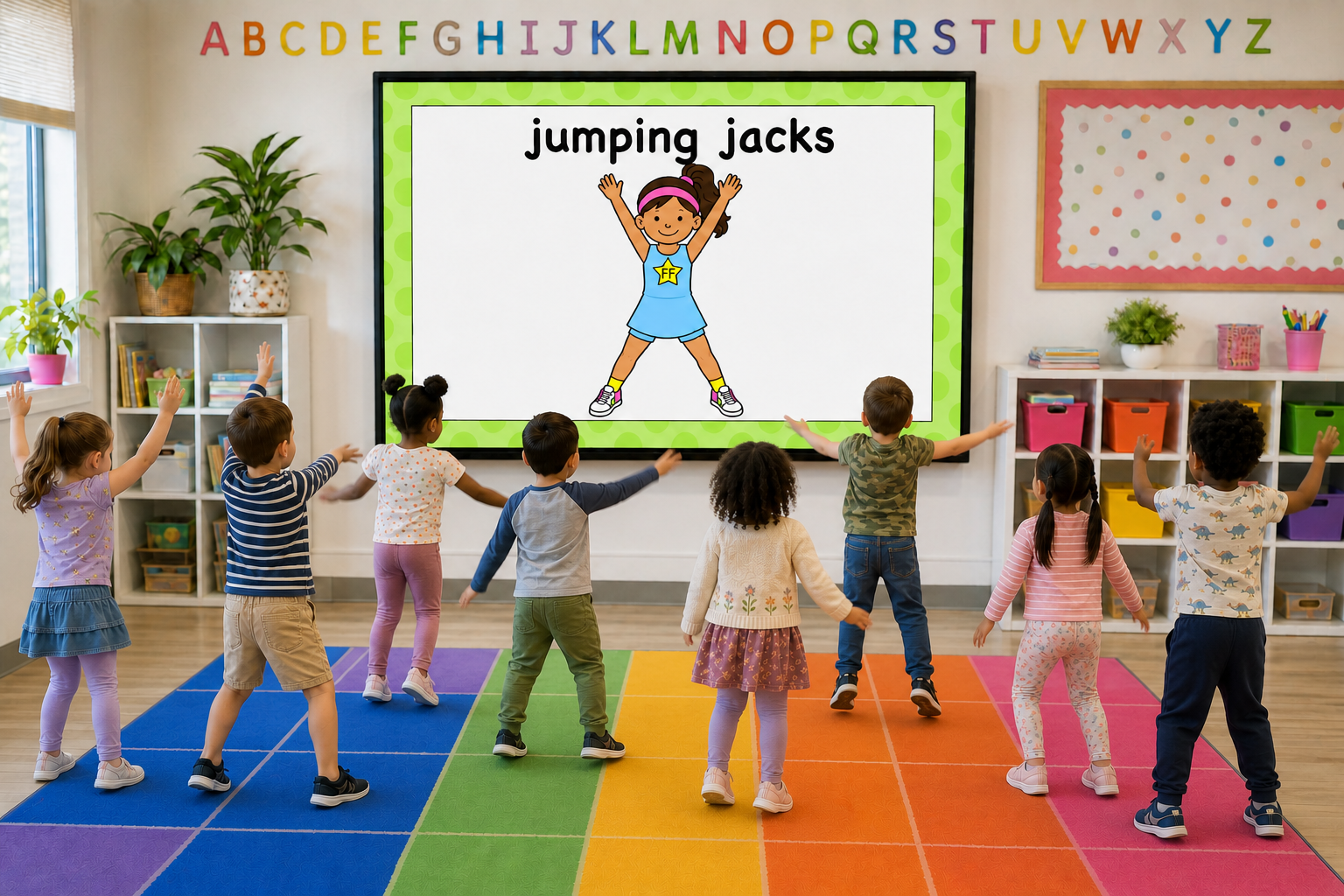
Kindergarteners follow a Fluency & Fitness+ movement activity while practicing together.
For the broader PreK–3rd version of this idea (and more grade bands), see Educational Brain Breaks.
Ready-to-play option
When you want the prompts and movement already paired for kindergarten literacy or math skills students are practicing, Fluency & Fitness+ is built for that — choose the skill, press play, and students respond and move together.
Get Free ActivitiesSee Membership OptionsMore movement + learning resources
Educational Brain Breaks for PreK–3rd → Start with the complete guide to combining movement and academic review.
Phonics with Movement → Go deeper into active phonics practice.
Moving Word Practice → Explore movement-based word recognition ideas.
Kindergarten brain break FAQs
How long should a kindergarten brain break be?
There isn’t one perfect length. Keep it short enough to feel like a reset rather than a new lesson. The right length depends on your class, the time of day, and the activity.
Do kindergarten brain breaks have to teach something?
No. Kindergarteners also need movement simply for movement’s sake. Educational brain breaks are useful when you want to combine a quick reset with review of something students already know.
Do I need a video or screen?
No. Teacher-led brain breaks work well. Ready-made activities are helpful when you want the academic prompts and movement already organized for you.
Can brain breaks be used during phonics?
Yes. Movement can be paired with review of phonemic-awareness and phonics skills, as long as the movement doesn’t distract from accurate listening, decoding, or pronunciation.
About Brittany Lynch
Brittany is a former kindergarten teacher and the creator of Fluency & Fitness+. She created the platform to help PreK–3rd teachers combine movement with meaningful literacy and math practice.